Our annual Novena of our patron Saint Thomas More will begin on June 13 at the end of the Saturday Vigil Mass, continuing during weekdays at 7 p.m., and at the end of Saturday and Sunday evening Masses.
Saint Thomas More’s feast day will be celebrated on June 22.
Saturday, June 13 at the end of the 5 p.m. Mass
Sunday, June 14 the end of the Sunday evening Masses
Monday, June 15 at 7 p.m. at the Chapel
Tuesday, June 16 at 7p.m. at the Church
Wednesday, June 17 at 7p.m. at the Church
Thursday, June 18 at 7p.m. at the Church
Friday, June 19 at 7p.m. at the Church
Saturday, June 20 at the end of the 5 p.m. Mass
Sunday, June 21 the end of the Sunday evening Masses
Click here for the Feast Day Litany and Novena Prayer
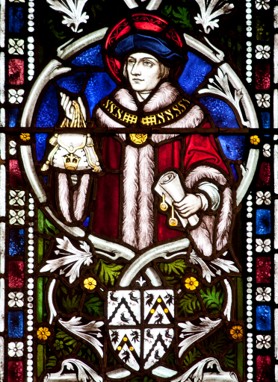
About our Patron
Sir Thomas More was born on February 7, 1477 to a Catholic family in London. A man of letters, he wrote numerous works of poetry, in both Latin and English. He also wrote academic prose, his most famous of which is The Utopia. As a family man, lawyer and statesman, he was also a loyal friend and servant of king Henry VIII who appointed him as Chancellor, the second most powerful person in England after the king. But circumstances were to evolve to the point where the king required a more absolute affirmation of loyalty than he could offer.
Thomas More resigned his post when the king abandoned the Catholic Church for its refusal to allow him to divorce his wife, Catherine of Aragon. He could not compromise his own moral values in order to please the king, knowing that true allegiance to authority is not blind acceptance of everything that authority wants.
The king saw this resignation and refusal to recognize him as supreme head of the Church of England as an act of treason. On July 6, 1535, St. Thomas More was beheaded on Tower Hill. Addressing the gathered crowd, he spoke: “I die in and for the faith of the holy Catholic Church. Pray for me in this world, and I shall pray for you in that world. Pray for the king that it please God to send him good counselors. I die as the king’s true servant, but God’s first.”
By his example, then, St. Thomas More challenges us to grow beyond ourselves, to seek the truth wherever it may lead, and to serve our world with grace and generosi